

Choosing board and flute
Board grade and flute size change how a carton prints, folds, stacks and travels. This guide explains the trade-offs so your packaging suits the product, the shelf and the route to market.
Start with the product before the carton
The right board does not start with a print finish or a preferred box style. It starts with the weight, shape and handling demands of the product inside. A light cosmetic carton and a heavier countertop appliance box may both look neat on shelf, but they need very different support from the board and flute profile.
For most jobs, we look at product mass, whether units are packed tightly or loosely, how the carton opens, and whether the pack must survive stacking in a warehouse or frequent movement through retail distribution. In Durban and across KwaZulu-Natal, humidity also matters. Board that feels firm in a dry room can soften slightly in coastal conditions, so allowance for transport and storage is often sensible.
- Check the packed product weight, not only the item weight.
- Note if there are glass components, pumps, cables or loose parts inside.
- Allow for warehousing, pallet stacking and courier handling.
- Consider whether the carton will be shelf facing, back of store stock, or both.
- Flag any exposure to coastal moisture during storage or delivery.
How board grade changes stiffness and finish
Board grade influences rigidity, edge quality, fold behaviour and the overall print surface. A higher grade can give a cleaner printed face and a more premium feel, while a more economical grade may suit high volume transit outers or packs where visual detail is less critical. The choice is rarely only about strength. It also affects how colour sits, how fine text reproduces, and how neatly the carton creases and closes.
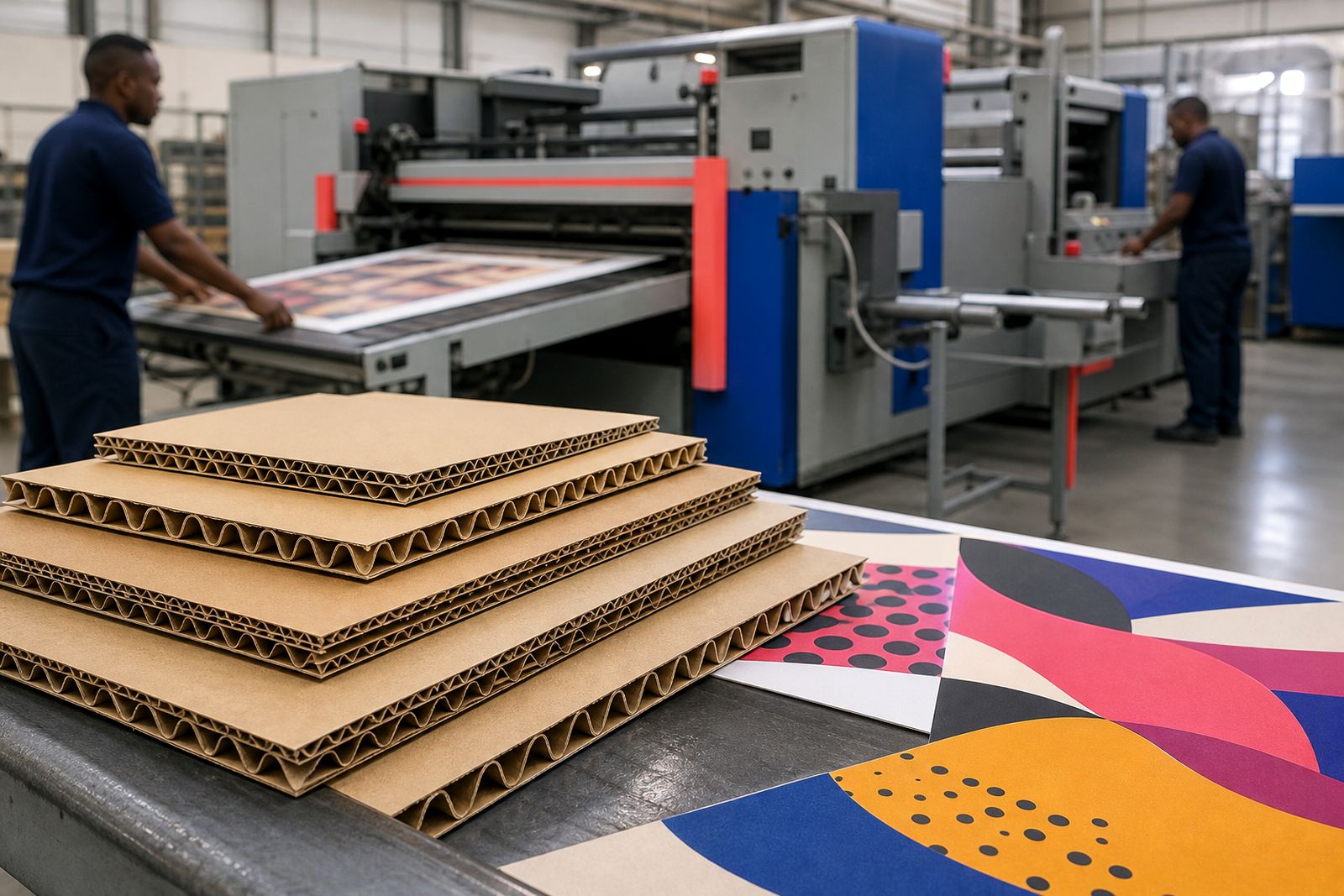
Folding cartons for personal care, food sleeves and promotional packs often need a smoother printable face because shelf impact depends on crisp graphics. Litho-laminated work adds another layer to the decision. When a printed sheet is laminated to corrugated board, the top print can look sharp while the underlying flute still contributes compression strength. That mix is useful where appearance and protection need to sit together.
There is usually a balance to strike between a lighter specification that saves material and a heavier one that reduces flex and panel bowing. Over-specifying can add cost and bulk without solving a real handling problem, while under-specifying can lead to corner damage, panel crush or a carton that feels weak in the hand.
Flute size is about more than thickness
Flute choice affects crush resistance, wall thickness, cushioning and how flat the final carton appears. Smaller flute profiles generally give a neater print presentation and tighter folds. Larger flute profiles can provide more stand-off and better protection for heavier or more fragile contents. Neither is automatically better. The correct flute depends on where the pack must perform.
For litho-laminated boxes, flute selection also affects edge definition and the way panels hold shape. A retail display pack may benefit from a finer flute where graphics and clean corners matter. A shipper or shelf ready box carrying multiple units may need a stronger profile that handles stacking pressure more confidently, especialy if the load is concentrated at the base.
- Finer flute profiles usually support a cleaner retail appearance.
- Larger flute profiles usually improve cushioning and compression.
- Thicker walls can change outer dimensions and pallet counts.
- Flute direction can affect fold performance on long panels.
- Some structures need a compromise between shelf look and warehouse strength.
Match the specification to the packing line
A carton can look right on a sample table and still create trouble during packing. If the board is too stiff, the carton may resist efficient forming or gluing. If it is too soft, panels can distort when product is loaded. For hand packing, there is often more tolerance. For faster filling lines and multi-stage packing, consistency matters a lot more.
We also consider how the carton closes. Locking tabs, glued seams, crash-lock bases and display perforations all place different demands on the substrate. Some structures need reliable memory at the crease, while others need edge strength so openings stay square after repeated handling. Where products are packed into trays or shelf ready outers, the inner carton and outer carton should be reviewed together rather than in isolation.
If your pack includes inserts, partitions or fitments, they may reduce the need for a heavier outer board. In other cases, the insert adds pressure points that call for more support. This is where samples and proofs help a lot because the carton can be assessed as a working pack, not only as a printed item.
A practical checklist for balancing print, strength and cost
Most packaging decisions sit between three pressures: appearance, protection and budget. Changing board or flute can move all three at once. A practical review keeps the job grounded and helps avoid late changes after artwork has been approved.
- List the carton’s main job: retail display, transit protection, shelf replenishment or a mix.
- Mark any print detail that needs a smooth face, such as fine copy or solid colour panels.
- Measure whether the pack must stack high in storage or on pallets.
- Check if the product has sharp edges or concentrated weight points.
- Review the total packed dimensions because thicker board changes fit in cases and on shelf.
- Consider whether moisture resistance or extra surface protection is needed.
- Test a sample under normal handling rather than only inspecting a flat sheet.
Material choice always affects the final carton cost, but chasing the lowest board specification can be false economy if cartons mark easily, lean on shelf or fail during distribution. A sound spec usually lands in the middle: enough structure for the route to market, enough print quality for the brand, and no unnecessary weight where it adds little value.
What to send when you need a board recommendation
If you want us to assess board and flute options, send the packed product dimensions, estimated packed weight, the intended box style and where the cartons will be used. It also helps to mention whether the job is for food and beverage, cosmetics, electronics or a similar category because handling conditions differ from one line to another.
Artwork files are useful, but they are only one part of the picture. A plain dieline, a mock-up, or photos of the product packed for market can tell us a great deal. If there are concerns about shelf impact, crushed corners, panel bowing or transport wear, say so upfront. That lets the print and converting stages be planned around real risks, not guesses.
Where needed, we can review samples and proofs before full production so the chosen construction makes sense for printing, laminating, die cutting and gluing. For project details, use our contact form.
What our Packaging customers say
Verified Google reviews
Questions we get asked
Is a thicker flute always stronger?
Not in every application. A larger flute can improve cushioning and compression, but carton design, board grade, pack weight and stacking method all influence real-world strength.
Can fine retail print work on corrugated cartons?
Yes. Litho-laminated cartons are often used where printed appearance matters but the pack still needs the support of corrugated board underneath.
Does board choice affect delivery and storage efficiency?
Yes. Heavier or thicker specifications can change carton outer size, pallet yield and case count, so the material choice can influence transport and warehouse planning.
Also worth a look
Tell us about the job
Send sizes, materials and where you are through our contact form, and we will come back with the practical options.
Open the contact form